
Managing customer relationships gets more difficult as a distribution business grows.
Sales teams may work across multiple territories, manage hundreds of customer accounts, visit customers regularly, and follow up on opportunities. At the same time, customer information sits across spreadsheets, emails, notes, and different business systems. When that information is disconnected, sales managers have less visibility, representatives can miss follow-ups, and customers may not receive consistent service.
This is where a CRM for distributors can make a difference.
A CRM gives distribution businesses a centralized way to manage customer accounts, sales opportunities, interactions, follow-ups, field activity, and account history. The right system can help sales teams work more efficiently while giving Sales Directors, Operations Managers, and Business Owners better visibility into customer relationships and sales performance.
For distributors evaluating CRM software, the goal should not be to add another system. It should be to find a solution that fits the way the business manages customers, sales, and growth.
Why Do Distribution Companies Need a CRM?
Distribution businesses already rely on systems for accounting, inventory, orders, warehouses, and other operational processes. These systems are important, but they may not give sales teams the complete picture of the customer relationship.
A CRM fills that gap.
A sales representative should be able to quickly see:
- Who manages the customer account
- When the customer was last contacted
- What opportunities are open
- What happened during the last visit
- Which follow-ups are due
- What products or services the customer is interested in
- Whether the account is growing or becoming inactive
Having this information available makes it easier for sales teams to act on what is happening with each account instead of relying on scattered notes or memory.
8 Benefits of CRM for Distributors
1. Centralize Customer and Account Information
One of the biggest benefits of a CRM for distribution is having customer information in one place.
A distribution company may have several employees interacting with the same customer. A sales representative may manage the account, customer service may handle a request, and other teams may need access to the account history.
When each person maintains separate information, the business can lose important context.
A CRM can bring together:
- Customer details
- Contacts
- Account history
- Sales activity
- Customer conversations
- Meetings
- Visits
- Follow-up tasks
- Opportunities
- Notes
This gives sales and customer-facing teams a common view of the account. It also makes it easier for another employee to pick up the account when it is transferred or when a team member is unavailable.
2. Improve Sales Pipeline Visibility Sales visibility becomes increasingly important as a distribution business grows.
Without a centralized pipeline, managers may have to rely on individual sales representatives for updates. This makes it harder to identify stalled opportunities, understand the overall pipeline, and decide where the sales team needs to focus.
A distributor CRM can give managers visibility into:
- New opportunities
- Qualified prospects
- Open deals
- Proposals
- Negotiations
- Stalled opportunities
- Upcoming follow-ups
- Sales activity
Instead of waiting for a weekly spreadsheet or sales meeting to understand the pipeline, managers can see what is happening across opportunities and identify where attention is needed.
Sales representatives can use the same information to prioritize their next actions.
3. Track Customer Orders and Buying Activity
Customer relationships in distribution are closely connected to purchasing behavior.
A customer may regularly purchase specific products, order at particular intervals, or gradually reduce their purchasing activity.
Understanding these patterns can help sales teams have more relevant conversations.
Customer and account data can help identify:
- High-value customers
- Frequently purchased products
- Changes in buying activity
- Inactive accounts
- Cross-selling opportunities
- Upselling opportunities
- Accounts with growth potential
For example, if a customer regularly purchases one product category but has never purchased a related product, the sales representative may have an opportunity to introduce it.
The conversation becomes based on the customer’s existing relationship and purchasing behavior rather than a generic sales pitch.
4. Strengthen Customer Relationships
A strong customer relationship depends on context.
Customers do not want to repeatedly explain their requirements, previous conversations, or unresolved issues to different members of the sales team.
A CRM gives representatives access to the information they need before engaging with an account.
They can review:
- Previous conversations
- Recent activities
- Customer visits
- Open opportunities
- Follow-up commitments
- Account history
- Relevant customer information
This helps sales representatives continue conversations instead of starting from scratch.
For distributors managing a large number of accounts, maintaining this level of context can make customer engagement more consistent.
5. Connect Sales and Operations Around the Customer
Sales and operations have different responsibilities, but they are working toward the same customer outcome.
Sales teams manage relationships and opportunities. Operations teams may manage orders, inventory, fulfillment, and other processes.
When customer information is fragmented between these functions, it becomes harder to understand the complete account.
A connected CRM approach can help bridge that gap.
For example, when a customer contacts the business about an issue, the team should have enough account context to understand the customer’s relationship with the business rather than treating every interaction as an isolated request.
This is particularly valuable when CRM data can work alongside other business applications.
For distribution businesses, the result is a more connected view of the customer across sales and operational workflows.
6. Reduce Missed Follow-Ups and Lost Opportunities
Not every opportunity converts after the first conversation.
A prospect may need multiple calls, meetings, product discussions, quotations, and follow-ups before making a decision.
Without a structured system, these opportunities can easily be forgotten.
A CRM helps sales teams keep track of:
- Follow-up dates
- Calls
- Meetings
- Tasks
- Sales stages
- Notes
- Next actions
- Inactive opportunities
This gives representatives a clear view of what needs attention.
It also gives managers greater visibility into opportunities that have stopped progressing.
For a distributor with a large prospect and customer base, recovering neglected opportunities can be an important source of additional revenue.
7. Improve Field Sales and Customer Visit Management
Distribution sales often happens outside the office.
Sales representatives and territory managers may spend much of their time visiting retailers, wholesalers, stores, restaurants, or other customer locations.
Those visits generate valuable information.
If that information remains in notebooks, personal spreadsheets, or individual notes, the rest of the team may not have access to it.
A CRM for distributors can help field teams capture:
- Customer visits
- Conversations
- Customer requirements
- Product discussions
- Follow-up actions
- New opportunities
- Account updates
This creates a more complete customer history.
Sales managers can also understand what happened during customer visits without relying entirely on separate reports from each representative.
8. Make Better Decisions With Customer Data
A CRM becomes more valuable when customer information can support business decisions.
Instead of relying only on assumptions, distribution businesses can use customer and sales activity to identify patterns.
For example:
Which customers are most valuable?
Identify high-value accounts and prioritize relationship-building efforts.
Which customers have become inactive?
Identify accounts that may need re-engagement before the relationship is lost.
Which customers could buy more?
Use customer and purchasing information to identify cross-selling and upselling opportunities.
Which sales opportunities are stalled?
Give sales managers visibility into deals that may need intervention.
Which accounts are growing?
Identify customers with potential for deeper engagement.
The goal is not simply to collect customer data. It is to turn customer information into useful sales and account-management decisions.
When Is It Time to Invest in a Distributor CRM?
A CRM becomes more useful as customer management starts becoming difficult to keep track of manually.
If customer information is spread across spreadsheets and emails, sales representatives maintain their own notes, and managers have to rely on manual reports to understand the pipeline, the business is already spending time putting together information that should be readily available.
The same applies to field sales. When customer visits, conversations, requirements, and follow-ups are recorded separately by each representative, it becomes difficult for managers and other team members to understand what is happening with an account.
These challenges usually become more noticeable as the business adds more customers, sales representatives, and territories. At that point, managing customer relationships through individual records and disconnected systems becomes harder to scale.
A CRM can bring this information together and give sales teams a consistent way to manage accounts, opportunities, interactions, and follow-ups.
Choosing a CRM for Your Distribution Business
Choosing a CRM should start with the way your sales team works today, rather than with a list of features.
Start by looking at where customer information currently lives. Can representatives get the information they need before a customer visit? Can managers understand the pipeline without asking each salesperson for an update? Can the team see previous interactions, follow-ups, and opportunities from one place?
It is also worth looking at what happens beyond sales. Customer information may need to work alongside your existing business systems, particularly when sales activity is connected to orders, operations, or other parts of the business.
Adoption is another important consideration. A CRM can have an extensive feature set, but if representatives find it difficult to use or it does not fit into their day-to-day process, it will not solve the underlying problem.
The right CRM should therefore fit the way your distribution business operates, give your sales team access to the information they need, and work alongside the systems you already depend on.
Managing Customer Relationships With ArcCRM
For a distribution business, managing customer relationships is not limited to keeping a list of contacts. Sales teams need context around accounts, opportunities, customer visits, follow-ups, and buying activity to understand where each relationship stands.
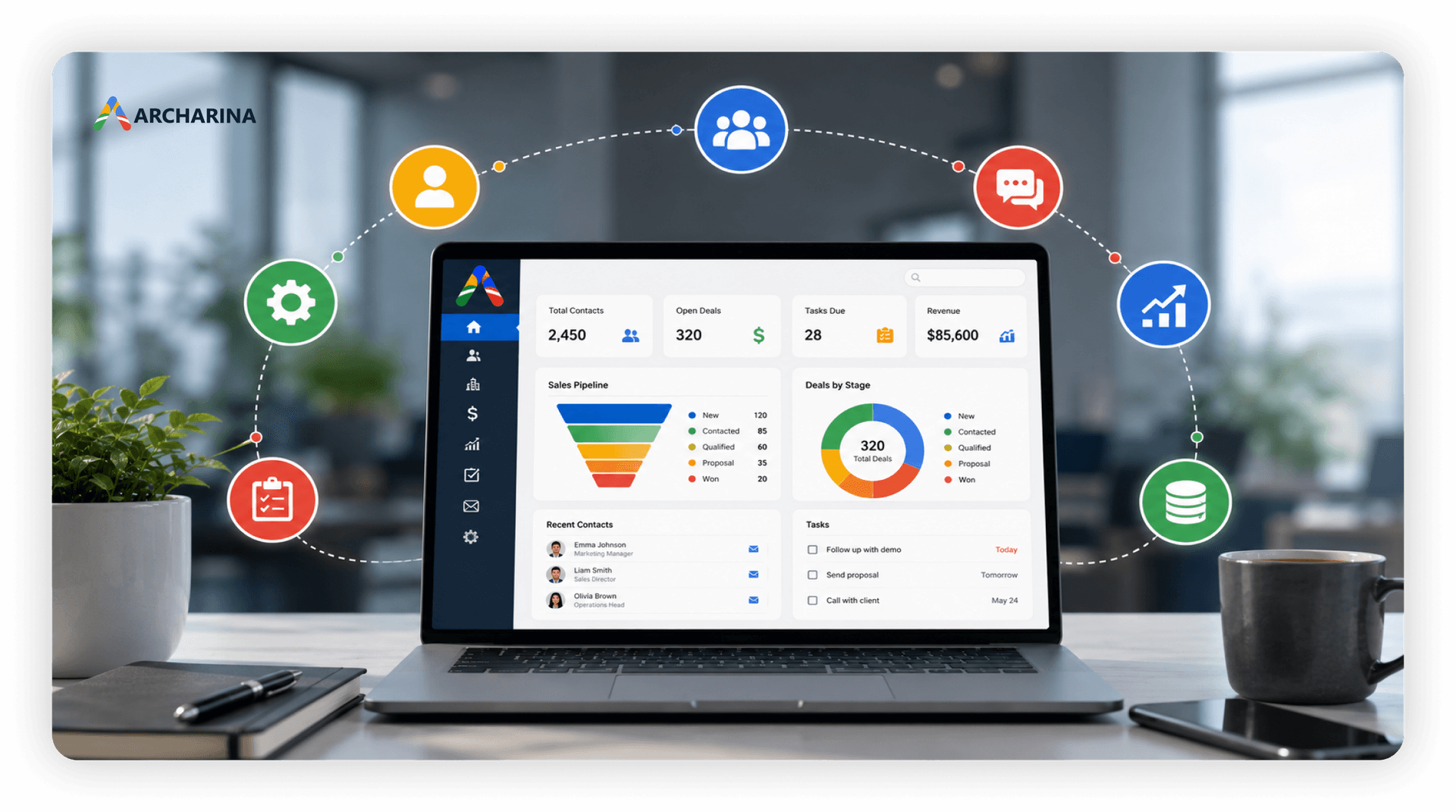
ArcCRM brings these activities together so sales teams can manage customer accounts, track opportunities, capture field interactions, and maintain customer history from one platform.
For businesses evaluating CRM for distributors, CRM for distribution companies, distribution CRM software, or a distributor CRM, ArcCRM provides a way to bring customer and sales information into a more connected workflow.
See How ArcCRM Works for Your Distribution Business
See how ArcCRM can help your team manage customer accounts, improve sales pipeline visibility, capture field activity, recover missed opportunities, and use customer information to support account growth.